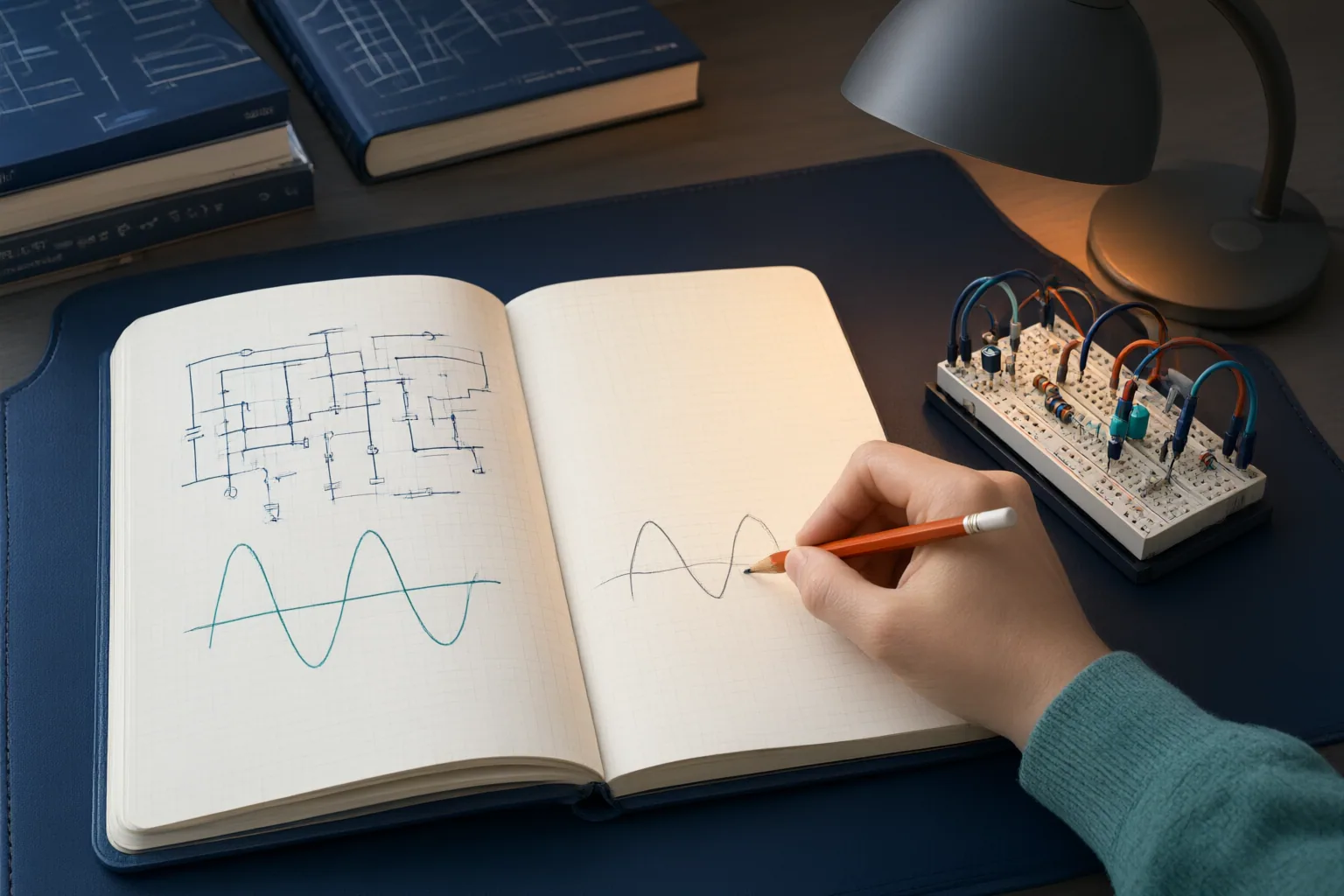
Retrieval practice replaces passive review with an attempt to produce knowledge from memory. For technical study, a practical approach is to reconstruct a definition, process, diagram, or solution, compare the attempt with the reference, correct errors, and revisit the concept later.
Why Retrieval Practice Works Differently From Rereading
Retrieval practice means bringing information to mind from memory instead of reviewing it again. That distinction matters when studying technical material: recognizing a familiar explanation or selecting an answer is not the same as independently generating the definition, reasoning through the process, or explaining why a solution works.
Rereading, highlighting, and watching review material may feel easier than recall. That ease, however, does not by itself demonstrate durable learning. Highlighting also has limited academic value when used alone in the cited summary, although it can become part of a more active process when followed by self-quizzing or a summary written from memory.
Retrieval need not resemble a high-pressure exam. It can take the form of a brief, ungraded task in which mistakes are expected and used as learning opportunities. The important feature is that the learner first tries to produce an answer rather than immediately looking at the source.

A Recall–Check–Correct Routine for Technical Concepts
A useful technical-study routine can be organized into five steps. This sequence is a synthesis of the retrieval, feedback, representation, and spacing practices in the supplied sources, not a directly tested protocol presented by those sources.
- Choose a small target. Select one definition, process, diagram, or worked solution rather than an entire subject.
- Close the reference. Remove the immediate cue provided by notes, a textbook, or review material.
- Reconstruct from memory. Write the definition, list and explain the steps, redraw the diagram, or solve the problem while showing the reasoning.
- Check the attempt. Compare the response with the source. Mark what was correct, incomplete, or mistaken.
- Correct and revisit. Produce a corrected version and plan another attempt later rather than treating the check as the end of study.
Feedback is essential after an error because it allows the learner to determine whether the attempted answer was correct. Keep the exercise low stakes: its purpose is to expose what can and cannot yet be produced from memory. If a complete closed-book attempt feels too difficult, an open-book retrieval task can still support retention more effectively than simply rereading, according to the cited Carnegie Mellon summary.

Choose a Retrieval Format and Space the Attempts
Match the activity to what you need to retrieve. Short-answer prompts and practice problems can target particular facts, steps, or solution methods. In one study described by the Carnegie Mellon summary, short-answer tasks favored later retrieval of the targeted information, while free recall favored retention of a broader range of information. For broader reconstruction, try recalling a lecture, paraphrasing a reading from memory, drawing a concept map, or creating a study guide without first consulting the material. Quizzes and exams are other possible retrieval activities.
Flashcards can support focused recall, but merely moving through cards does not guarantee retrieval practice. Pause and genuinely produce the answer before revealing it. When appropriate, explain the answer rather than relying only on a feeling of familiarity.
Distribute retrieval sessions over time instead of concentrating every attempt in one sitting. The supplied sources describe spacing across days, weeks, or months. There is no single interval specified for every topic: appropriate spacing depends on how well the material has been learned, its complexity, and how long it must be retained. After checking an attempt, choose a later time to reconstruct the concept again and use the new result to identify remaining gaps.
Conclusion
Retrieval practice is an adaptable alternative to simple rereading: it asks learners to generate knowledge, inspect the result through feedback, and return to it over time. The format can be narrow, such as a short-answer prompt, or broad, such as free recall or a concept map.
Choose one technical concept today. Close the reference, reconstruct the concept from memory, check the attempt, correct any errors, and schedule another retrieval attempt for a later session.
Disclosures and limitations
- This article was created with AI assistance from the supplied research package and was written to preserve its stated evidence boundaries.
- No products are recommended in this article, and no affiliate relationship is presented.
Related reading
Sources
- 15 Quick (and Mighty) Retrieval Practices — Edutopia
- Retrieval Practice: A Powerful Strategy for Learning — Pooja K. Agarwal, Ph.D.
- Retrieval Practice: 26 Strategies for Stronger Recall — Structural Learning
- Retrieval Practice for Improved Learning – Eberly Center – Carnegie Mellon University — cmu.edu
- Retrieval practice: the research and 6 recall formats to try – AhaSlides — ahaslides.com
- What is retrieval practice? — Pooja K. Agarwal, Ph.D.