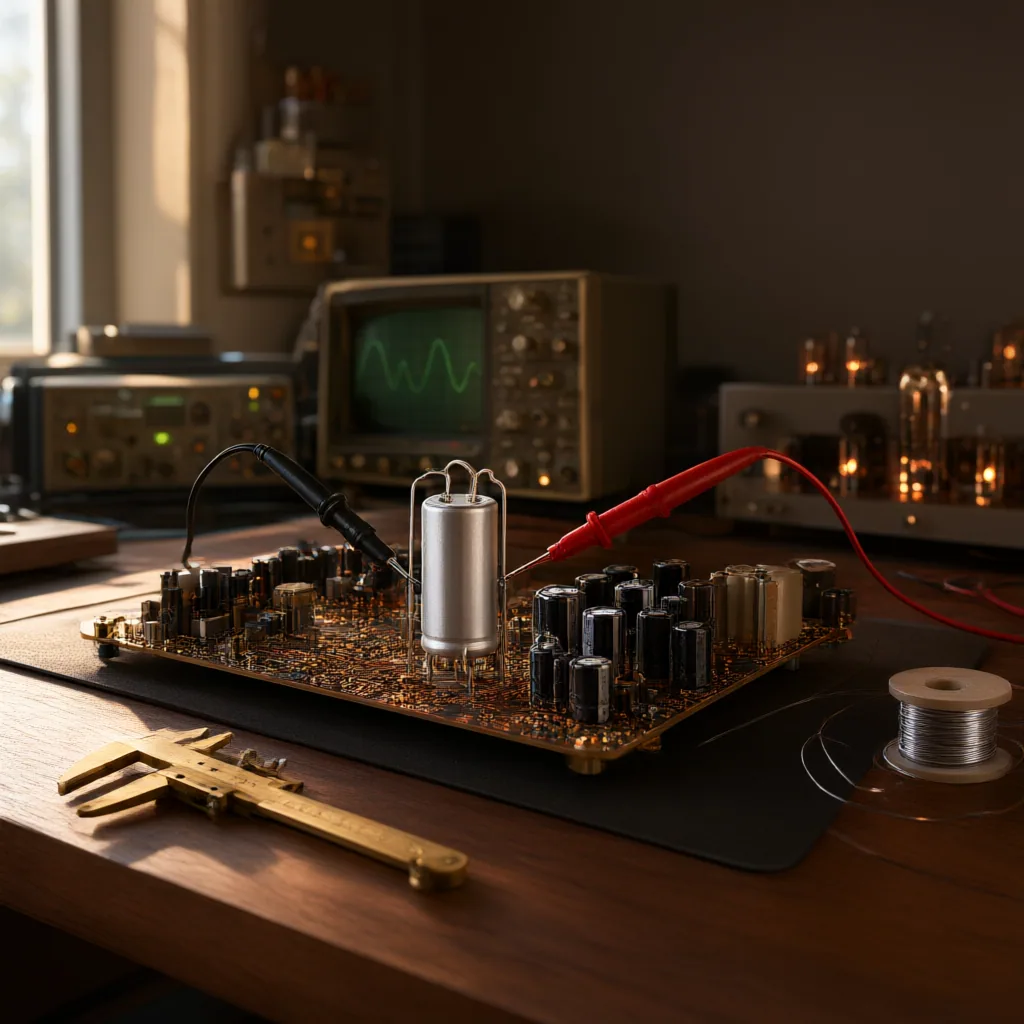
Capacitors influence more than frequency response. In audio paths they can also add low-level nonlinearity, shift timing, and interact with surrounding circuitry in ways that become audible as haze, softened transients, or a subtle change in tonal balance. For readers building, repairing, or evaluating audio gear, the useful question is not whether a capacitor is “good” or “bad,” but which distortion mechanisms matter in a given position and how to keep them under control.
Where distortion begins
An ideal capacitor stores and releases charge without loss or memory. Real parts depart from that model. The dielectric material can behave nonlinearly as voltage changes, the equivalent series resistance converts signal energy into heat, and the equivalent series inductance makes the part less capacitive at higher frequencies. None of these effects automatically ruin a design, but they explain why two circuits with the same nominal capacitance can behave differently under signal.
Dielectric nonlinearity and voltage dependence
One important mechanism is dielectric nonlinearity. If capacitance changes with applied voltage, the signal sees a moving component value rather than a fixed one. In coupling, filter, or feedback positions, that can produce harmonic distortion. This is one reason capacitor choice matters more in some signal-carrying locations than in supply decoupling roles. Ceramic formulations, for example, vary widely: some are stable and predictable, while others are better reserved for duties where voltage-dependent behavior is less critical to audio performance.
Dielectric absorption and memory effects
Dielectric absorption is often described as a memory effect. After charging and discharging, a capacitor may appear to recover part of the previous voltage. In audio this can blur very small details because stored energy is not released perfectly in step with the waveform. The effect is usually subtle, but it becomes more relevant in high-impedance stages, timing networks, and precision filter sections where small errors are easier to expose.
Losses, impedance, and frequency interaction
Equivalent series resistance and leakage current introduce their own penalties. ESR changes how a capacitor behaves across frequency and can reduce the effectiveness of bypassing or alter the intended filter shape. Leakage can upset bias conditions in sensitive analog stages. At the same time, parasitic inductance limits high-frequency usefulness, especially when layout forces long leads or traces. In practice, distortion is often not caused by one parameter alone but by the combined interaction of dielectric behavior, source impedance, load impedance, and operating voltage.
Why circuit position matters more than brand debates
A capacitor in a loudspeaker crossover, a phono stage, and a power supply reservoir does not face the same electrical demands. Signal-path parts deserve attention to linearity, tolerance, and long-term stability. Power rails usually prioritize ripple handling, impedance, and reliability. Repair work adds another layer: replacing an old part with the wrong dielectric, voltage rating, or physical layout can change the circuit more than expected even when the capacitance number matches.
Practical ways to reduce audible problems
Useful evaluation starts with the schematic position. Check signal level, DC bias, impedance, and frequency range before judging replacement options. Favor parts with stable electrical behavior in critical audio paths, keep lead lengths short, and avoid assuming that larger or more expensive automatically means cleaner sound. When troubleshooting, compare measured operating conditions against the intended design rather than relying on listening impressions alone. That approach usually reveals whether the real issue is capacitor distortion, aging, layout parasitics, or another stage in the chain.
For audio enthusiasts and DIY readers, understanding capacitor distortion mechanisms turns vague component folklore into a clearer engineering question: what non-ideal behavior is present here, and is this circuit position sensitive enough for it to matter?