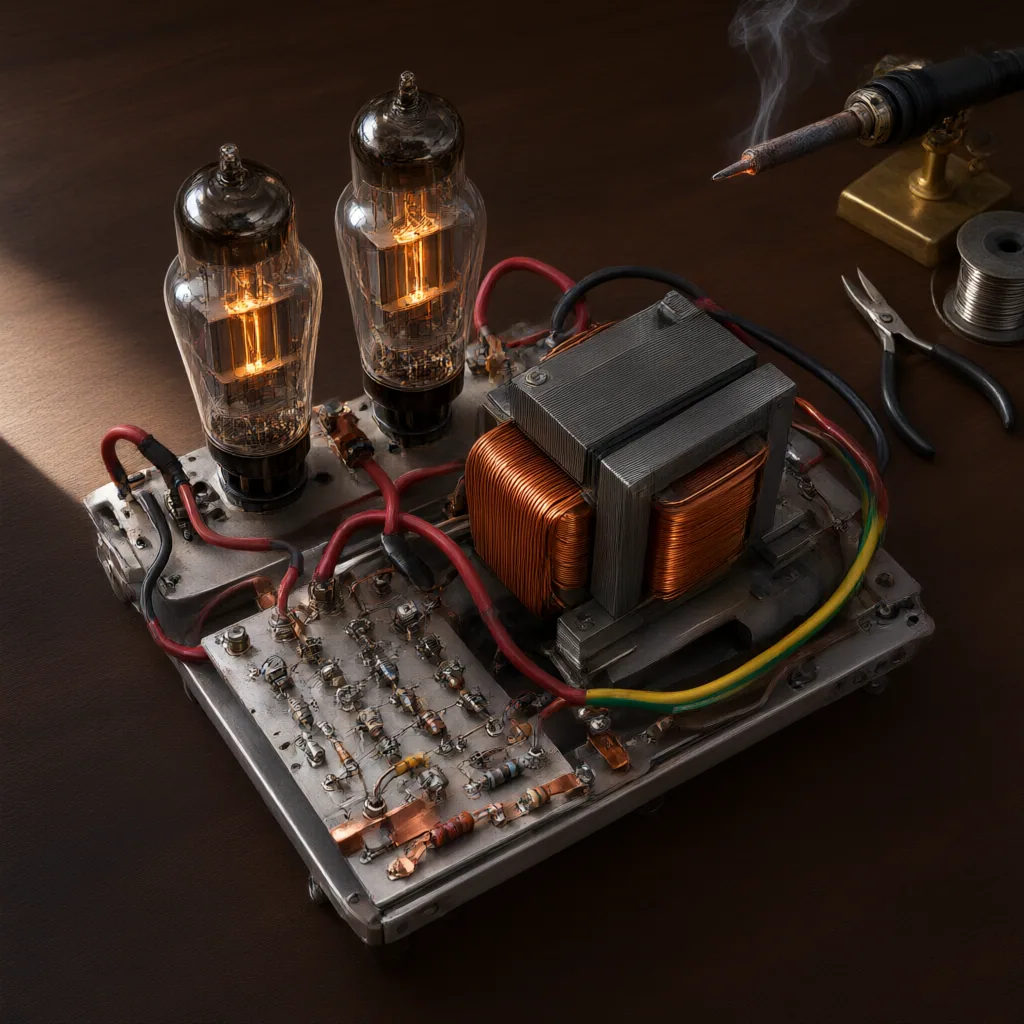
Vacuum tube amplifiers appeal to listeners because they turn a tiny audio signal into speaker-driving power through a signal path that is both electrically elegant and easy to study. If you are trying to understand why tube gear behaves differently from many solid-state designs, the useful starting point is not mystique but function: gain stages, power supply behavior, output matching, and operating limits.
The tube as a control device
A vacuum tube controls current flow in an evacuated glass envelope. In a typical audio tube, a heated cathode releases electrons, a plate attracts them, and one or more grids between those elements regulate how much current can pass. A small change in voltage at the control grid can create a much larger change in plate current, which is the basis of amplification.
In practical audio circuits, preamp tubes handle small incoming signals from a source component, while larger output tubes deliver the current and voltage swing needed for the loudspeaker load. Different tube families are built for different jobs, so the circuit matters more than the label on the glass.
Following the signal through the amplifier
Most vacuum tube amplifiers use several stages. First, an input stage raises the low-level music signal without adding too much noise. Next, a driver or phase-splitting stage prepares the waveform for the output section. In push-pull designs, two output devices share the waveform, with one handling one half of the cycle and the other handling the opposite half. In single-ended designs, one output device carries the full waveform continuously.
That output stage still cannot drive a speaker directly in the usual way. Tubes prefer to work at high voltages and relatively low current, while loudspeakers need the opposite relationship. The output transformer solves this mismatch by converting the tube stage’s operating conditions into something more suitable for the speaker terminals.
Why transformers and power supplies matter so much
The output transformer is a defining part of many tube amplifiers. Its winding ratio determines how the speaker impedance is reflected back to the output tubes, and that affects power delivery, distortion behavior, and stability. Transformer quality also influences bandwidth, especially at the frequency extremes where magnetic limits become more obvious.
The power supply is just as important. Tube amplifiers rely on high-voltage DC rails, heater supplies for warming the cathodes, and filtering that reduces hum. Because the supply can respond differently under load than a stiff solid-state design, tube amplifiers may show a softer clipping character or a sense of dynamic compression when pushed. That does not make every tube amplifier automatically warm or forgiving, but it does explain why power supply design is part of the sound.
Operating classes and audible behavior
Many vacuum tube amplifiers are described by operating class, such as Class A or Class AB. These labels refer to how long an output device conducts during each waveform cycle. The choice affects efficiency, heat, distortion pattern, and power output. Negative feedback can also be applied to reduce distortion and flatten frequency response, though it changes how the amplifier reacts to complex loads.
For listeners, the real takeaway is that tube sound is not one fixed character. Circuit topology, transformer design, bias method, speaker matching, and maintenance condition all shape the result more than the presence of tubes alone.
Safety and ownership realities
Tube amplifiers contain potentially lethal voltages, and stored charge can remain inside capacitors even after the unit is switched off. That makes internal service a job for trained technicians or well-prepared builders who understand discharge procedures, measurement safety, and high-voltage layout practice.
Routine ownership is more manageable: allow ventilation, avoid blocking heat around the chassis, use the correct speaker tap when the design provides one, and replace tubes only with compatible types approved for the circuit. If an amplifier hums excessively, runs unusually hot, or shows red-plating on an output tube, stop using it until the cause is checked.
A good way to read tube amplifiers is to see them as complete systems rather than nostalgic objects. Once you understand the gain stages, transformer coupling, and power supply behavior, their design becomes much less mysterious and much more useful.