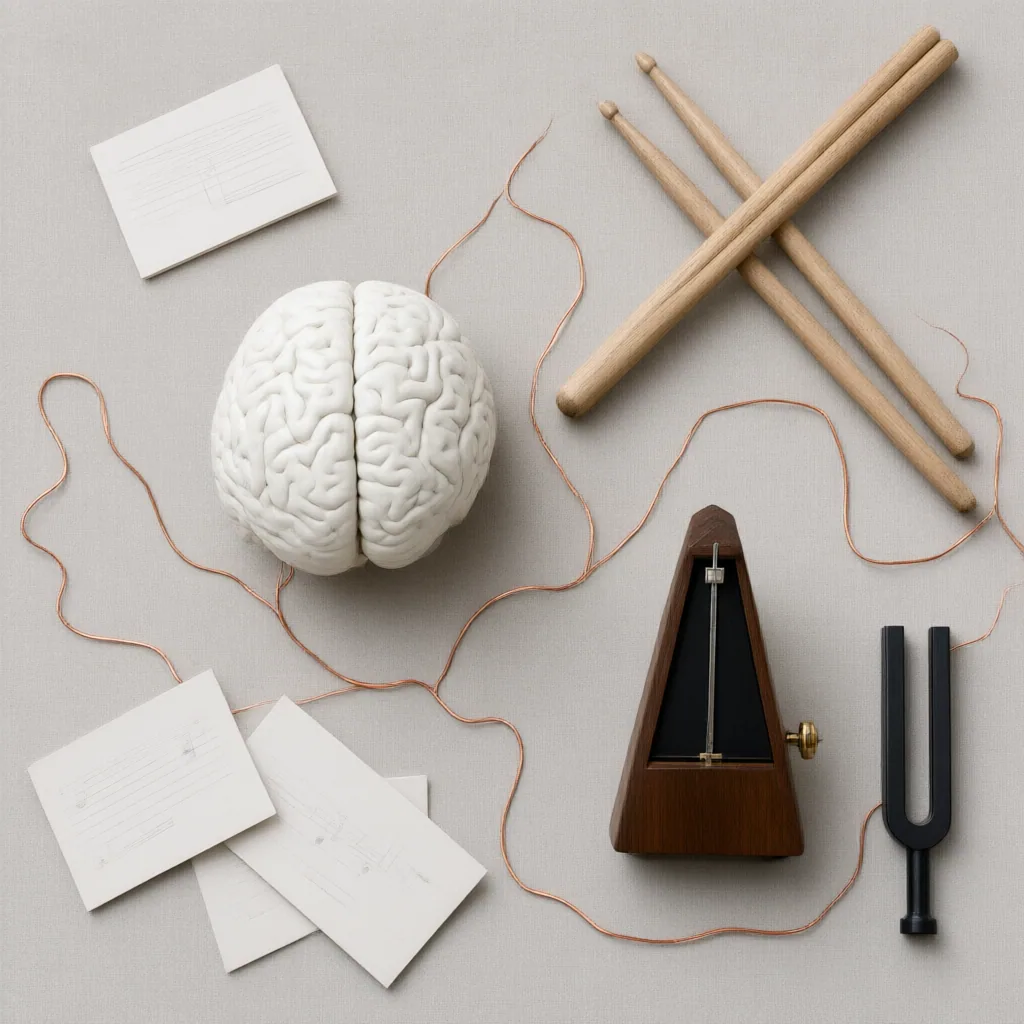
Musical training gives the brain a rare combination of demands: fine motor control, close listening, memory, timing, prediction, and emotional interpretation all happening at once. For students, performers, teachers, and curious readers, that makes musicians a useful case for understanding how practice can shape attention and learning over time.
Why musicians are studied so often
Researchers are interested in musicians because sustained practice engages multiple brain systems together rather than in isolation. Playing an instrument can involve hearing subtle pitch changes, coordinating both hands, reading notation, adjusting posture, and anticipating what comes next in a phrase. That combination makes music training a strong model for studying neuroplasticity, the brain’s capacity to adapt through experience.
This does not mean music automatically raises intelligence in a simple or universal way. A more careful reading is that regular training is associated with changes in how the brain organizes perception, movement, and learned responses. The size and importance of those changes depend on age, duration of practice, type of training, and the questions a study is actually measuring.
Brain systems often linked to music practice
Studies on musicians frequently focus on auditory processing, motor planning, memory, and attention. Skilled players may show more efficient responses to timing, pitch, and sound pattern differences because they repeatedly train those abilities in meaningful contexts. Practice also places heavy demands on sensorimotor integration: the brain must connect what is heard with what the hands, breath, or voice are doing in real time.
Some research also discusses growth-related processes in the brain, including the production of molecules associated with learning and adaptation. In broad terms, repeated, challenging practice may help support the conditions under which neural connections are strengthened. That is best understood as part of a larger learning process, not as a shortcut or a guarantee of broad cognitive improvement.
What music training may improve, and what it may not
The strongest claims usually stay close to the task itself. Music training can plausibly support better listening discrimination, rhythmic precision, coordinated action, and durable practice habits. It may also overlap with skills used in language perception, working memory, or sustained attention. But transfer outside music is often narrower and more uneven than headlines suggest.
That distinction matters. A person can become much better at reading rhythm, tracking harmony, or correcting finger placement without that automatically translating into across-the-board academic or professional gains. Good evidence separates direct training effects from broader claims about success, creativity, or intelligence.
Reading the evidence with care
When comparing studies about the brains of musicians, it helps to ask a few practical questions: Were the participants children or adults? How long had they trained? Were they amateurs or professionals? Was the study measuring brain activity, structure, behavior, or all three? And did it show correlation, or was it testing a specific intervention over time?
Those details shape the conclusion. Music training remains one of the clearest real-world examples of complex learning in action, but it should be framed accurately. The value of this research is not that it offers a miracle formula. It shows how disciplined, repeated, meaningful practice can influence perception, coordination, and the brain systems that support skilled performance.