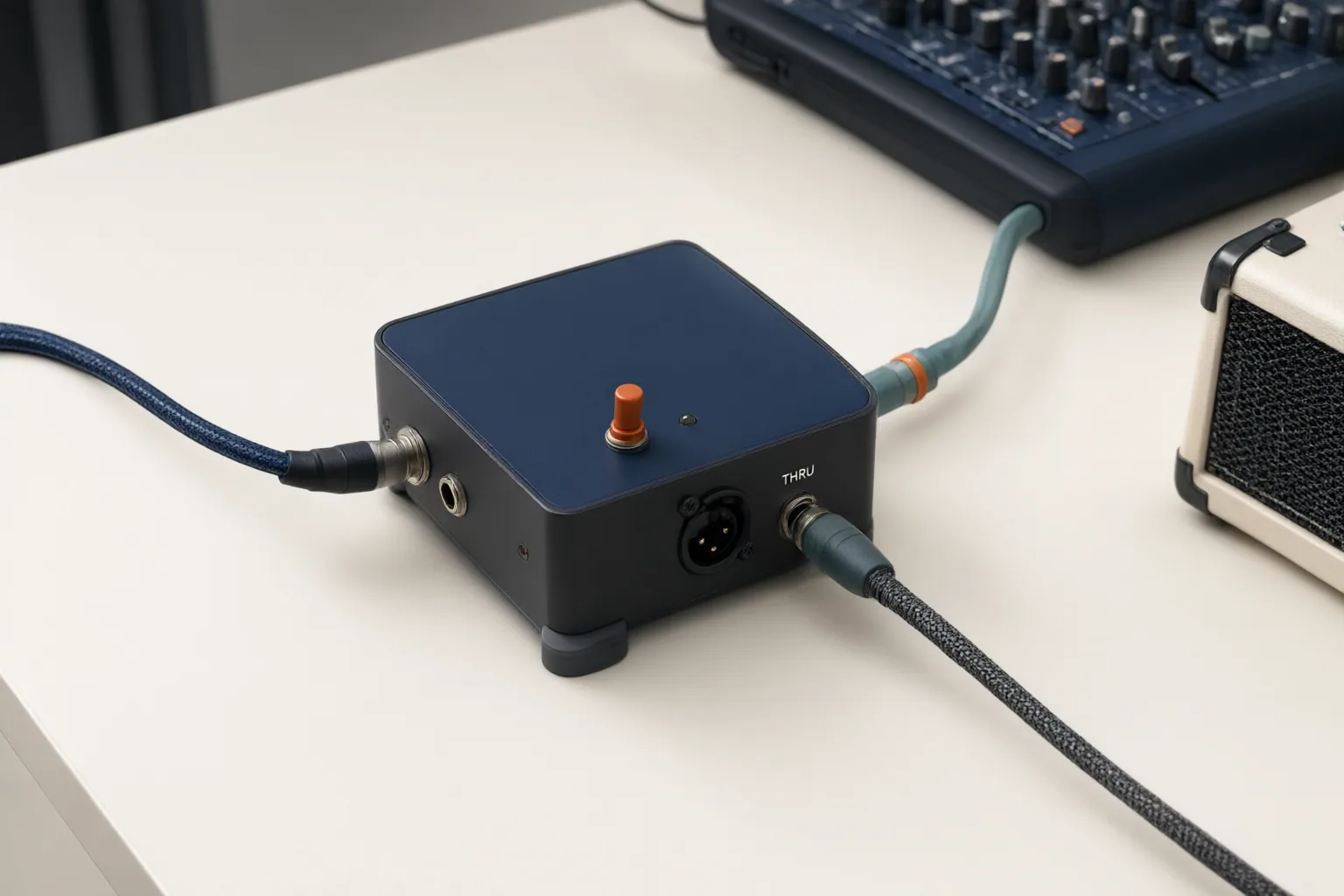
A DI box sits between a suitable non-microphone source and a mixing console, adapting the signal for further processing and commonly providing a balanced, low-impedance output. When a separate stage-amplifier feed is needed, a THRU connection can route the instrument signal to both destinations.
What a DI Box Does to the Signal
A DI box adapts audio signals of different types and levels into a form suitable for the next part of a signal chain. A common application is converting a high-impedance instrument signal to a low-impedance signal and supplying a balanced output for a mixing console.
This makes a DI useful when connecting certain non-microphone sources to a mixer. Supported examples include guitar, bass, electric violin, keyboard, and laptop. These examples describe typical applications, not a rule that every such source always requires a DI box. Whether one is appropriate depends on the source, the available inputs, and the intended routing.
The essential idea is signal adaptation: the source enters the DI, and the DI presents an output intended for further processing by the mixing system. It does not replace every other part of the chain or determine how the mixer should process the resulting signal.
Where the DI Box Connects
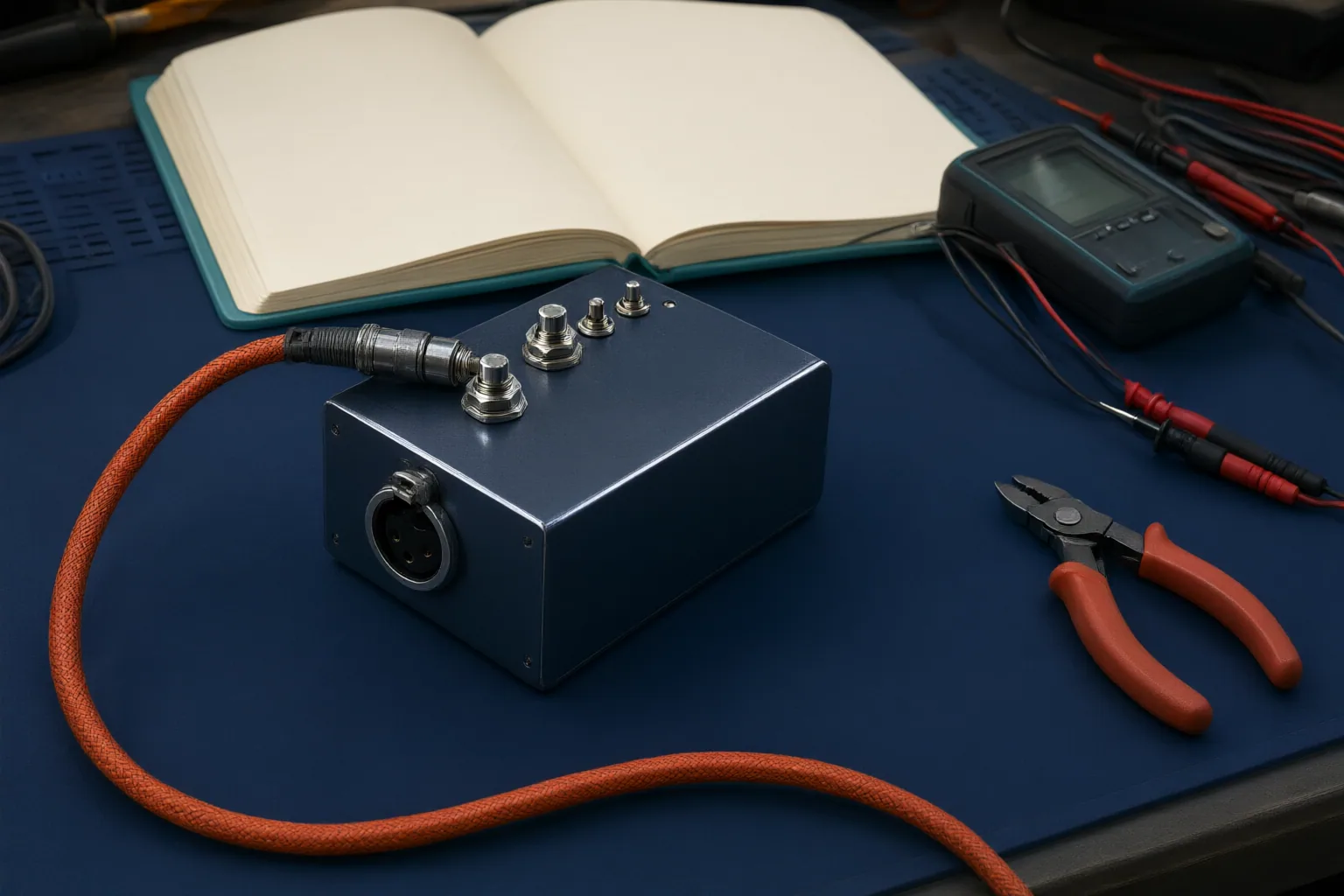
For a straightforward mixer feed, connect the instrument or other supported source to the DI box’s input. The DI’s balanced output then connects to the mixing console. In signal-flow form, the path is:
Instrument or source → DI input → balanced DI output → mixing console
A stage setup may also require the instrument to feed an amplifier while the mixer receives its own signal. A DI box equipped with a THRU output can support that arrangement. The source still connects to the DI input, the balanced output goes to the mixer, and THRU sends a separate feed toward the stage amplifier:
Instrument → DI input → balanced output to mixer DI THRU output → stage amplifier
The cited sources describe this arrangement as allowing the signal to reach the mix and amplifier simultaneously. Labels can vary by unit, so identify the input, balanced output, and THRU connection from the device markings and documentation before connecting cables.
PAD, Ground Lift, and Active vs Passive Designs
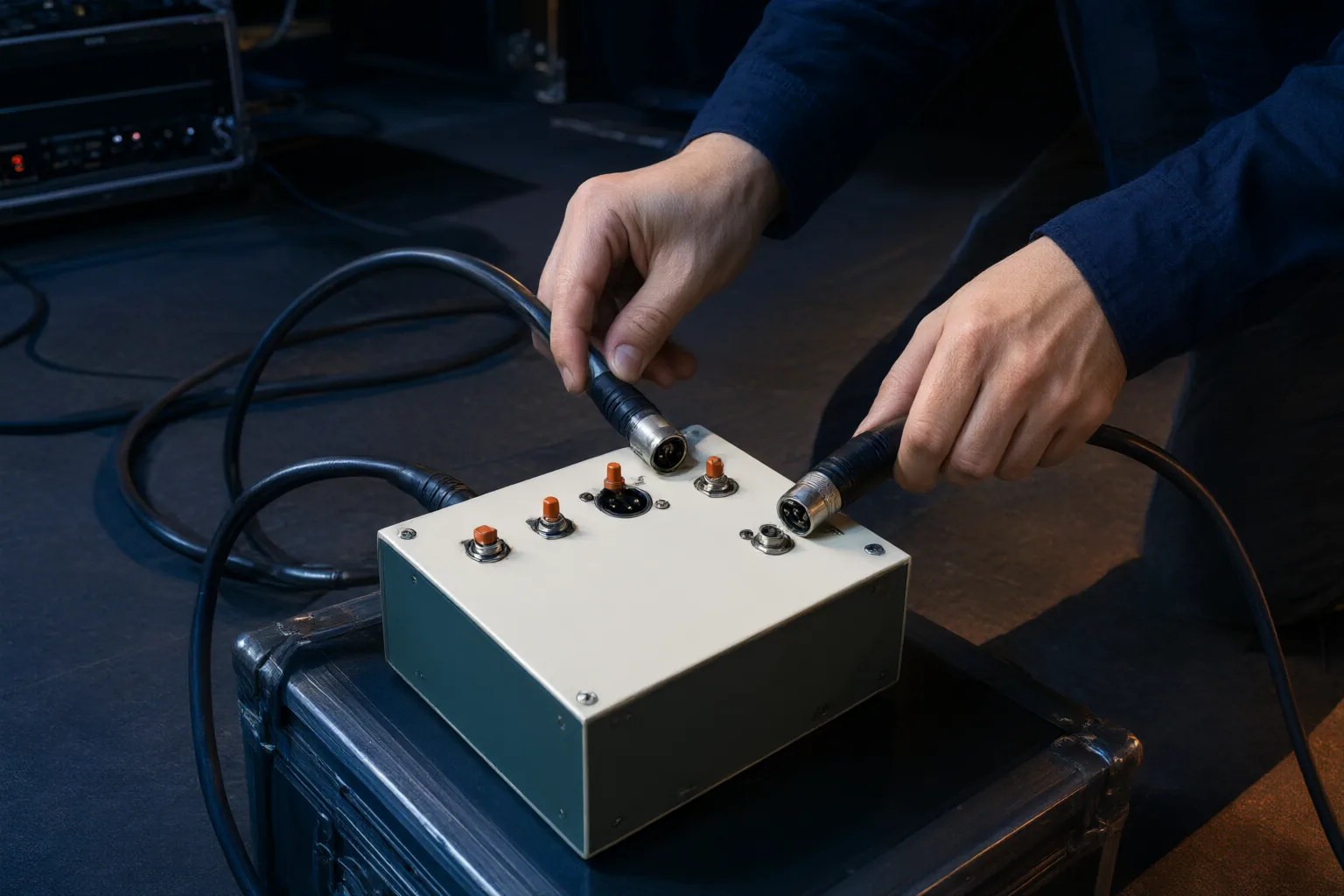
Some DI boxes provide controls for particular signal and connection conditions. A PAD attenuates the incoming signal and is relevant when a stronger source level needs to be reduced. It should not be treated as a control that must always be engaged; its stated purpose is to help the DI handle higher-level signals.
Ground Lift is intended to help address hum associated with ground loops when multiple devices are interconnected. The source describes it as a potentially helpful control, not a guaranteed cure for every kind of noise. If hum is present, confirm the routing and consult the specific unit’s documentation before changing the control.
DI boxes are also available in passive and active designs. The cited retailer overview markets passive models in its own range for neutral operation and active models for intentional tonal coloration. That description belongs to the referenced product line and should not be generalized into a universal rule about the sound of every active or passive DI. When comparing designs, rely on the documentation for the particular units under consideration rather than assuming that the active-or-passive label alone establishes their sound character.
Conclusion
A DI box commonly occupies the link between an instrument-level or other suitable non-microphone source and a mixing console, adapting the signal and providing a balanced, low-impedance output. When the instrument must also reach a stage amplifier, THRU can preserve that additional feed. PAD and Ground Lift address specific level and connection concerns, while active and passive descriptions require product-specific context.
Before making connections or adjustments, trace the intended path from source to mixer and amplifier. Then locate the instrument input, balanced mixer output, optional THRU amplifier feed, PAD, and Ground Lift on the specific DI box and check its documentation.
Disclosures and limitations
- This article was prepared with AI assistance from the supplied research package, which cites a Czech-language Wikipedia article and a retailer-authored overview; claims were limited to those sources and are not presented as independent laboratory findings.
- No products, prices, ratings, or reviews were supplied or recommended. If commercial links are added later, any affiliate relationship should be disclosed clearly.
Related reading
Sources
- DI-Box – Wikipedie — cs.wikipedia.org
- Heritage Audio: P DI & 73 DI – Dvě cesty k dokonalému signálu — DISK Multimedia, s.r.o.