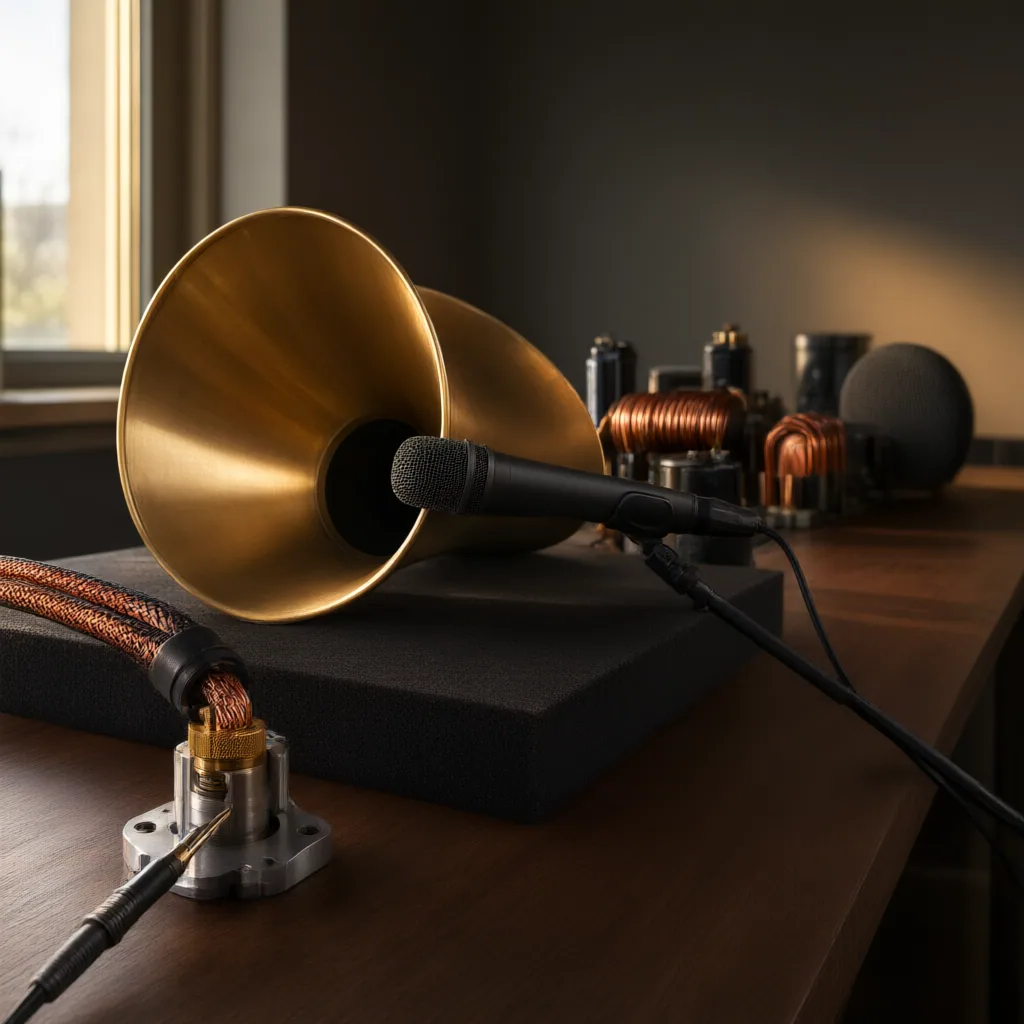
Acoustic and electrical impedance describe resistance to motion or signal flow, but they apply in different domains and use different reference quantities. Understanding that distinction helps when you compare microphones, loudspeakers, headphones, instruments, rooms, and amplifiers without mixing up terms that only look similar on the surface.
Why impedance matters in audio
In audio work, impedance affects how energy moves from one part of a system to another. Acoustic impedance relates sound pressure to particle velocity in a medium such as air, a tube, or an instrument body. Electrical impedance relates voltage to current in a circuit and includes both resistance and frequency-dependent reactance. Both ideas matter because audio systems are full of changing conditions: frequency shifts, resonances appear, and the source and load rarely behave like simple fixed values.
That is why the word itself is useful but incomplete unless the context is clear. A loudspeaker may have a nominal electrical impedance, yet its actual impedance changes across frequency. An acoustic tube or horn may guide sound efficiently at one range and reflect energy at another. When readers see a single number on a specification sheet, it should be treated as a shorthand, not the whole behavior.
Acoustic impedance in practical terms
Acoustic impedance helps explain why sound travels differently through air, wood, metal, foam, and the narrow passages inside wind instruments or speaker enclosures. When the impedance of two acoustic regions differs strongly, more sound energy is reflected at the boundary instead of passing through. That principle shapes room treatment, instrument design, ear coupling, and enclosure tuning.
A simple way to think about it is this: if the medium or passage resists particle motion for a given sound pressure, the acoustic impedance is high. If motion happens more easily, it is lower. This does not automatically mean high is better or worse. The useful question is whether the impedance condition supports the result you want, such as efficient radiation, controlled resonance, reduced reflection, or predictable loading.
Electrical impedance and frequency dependence
Electrical impedance is the broader circuit concept behind familiar labels such as 4 ohms, 8 ohms, 32 ohms, or 600 ohms. Unlike pure resistance, impedance changes with frequency when capacitors, inductors, voice coils, transformers, or crossover networks are involved. That matters because audio signals are not single steady tones. They span a band of frequencies, and the load presented to an amplifier or source can vary across that band.
For headphones and line-level gear, impedance influences compatibility, available level, noise performance, and current demand. For loudspeakers, it affects amplifier loading and heat stress. A nominal impedance rating is useful for system planning, but it does not replace the need to check sensitivity, output capability, and the real operating range of the equipment.
Why “matching” is often misunderstood
People often hear that impedance must always be matched. In practice, audio uses different relationships for different jobs. Power transfer concerns one set of conditions; signal bridging and low-distortion interfacing often favor another. A microphone input, line output, headphone jack, and speaker terminal should not all be judged by the same rule.
This is where mistakes happen. Someone may compare acoustic impedance in an instrument bore with electrical impedance at an amplifier output as if they were interchangeable ideas. They are analogous in structure, not identical in use. The safer habit is to ask three questions: what quantities are being related, how does frequency change the result, and what system goal matters here?
Reading specs with better judgment
When you evaluate audio hardware or explanations online, look for context instead of isolated numbers. Ask whether the value is nominal or frequency dependent, whether it refers to an acoustic path or an electrical circuit, and whether the claim is about compatibility, efficiency, control, or tone. That keeps impedance in its proper role: a powerful interpretive tool, not a buzzword.
Used carefully, impedance helps connect acoustics and electronics into one clearer picture of how audio systems behave in the real world.