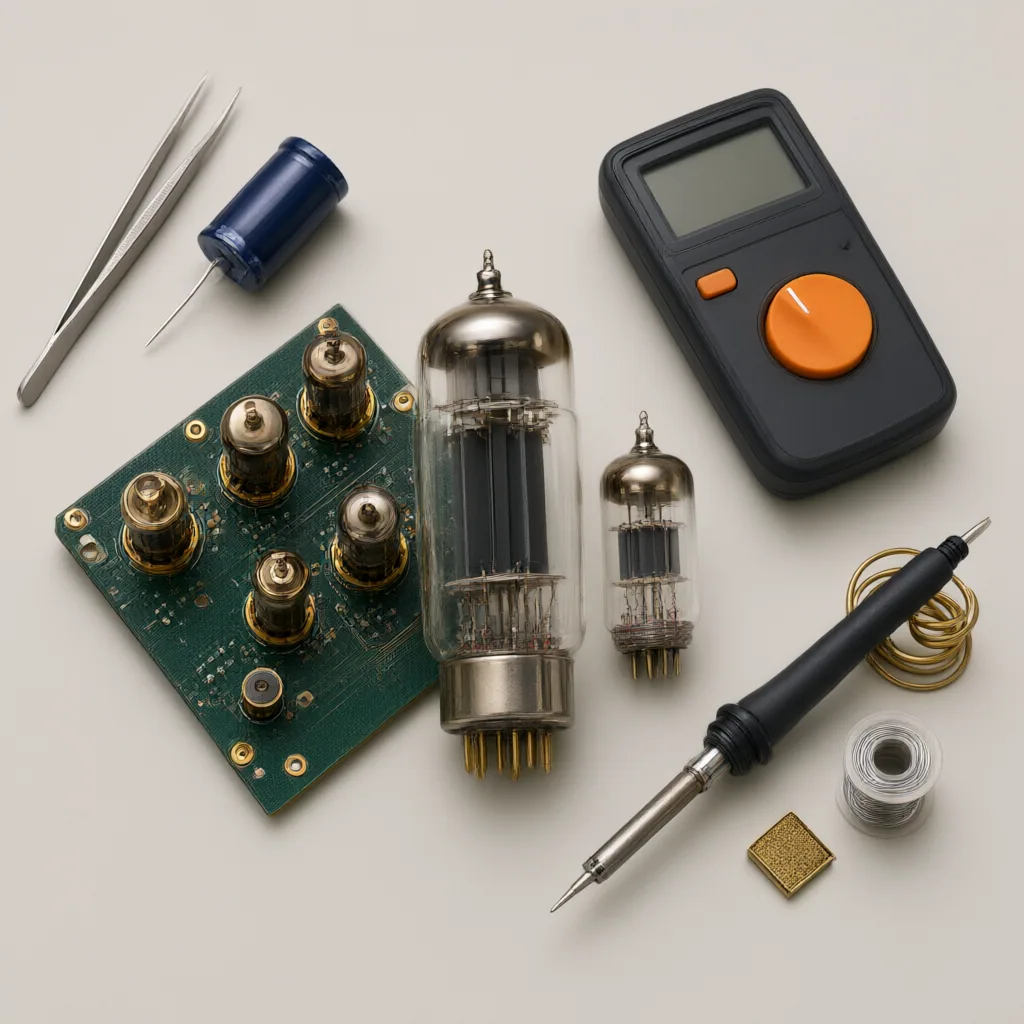
Vacuum tubes still matter in audio because they do different jobs inside an amplifier, preamp, or source stage, and those jobs affect gain structure, headroom, noise, heat, and serviceability. If you are comparing tube gear, maintaining older equipment, or planning a build, the useful question is not whether tubes are “better” in the abstract. It is which tube family is being used, where it sits in the circuit, and what that means for operation and compatibility.
Small-signal tubes in preamp stages
Small-signal tubes are commonly used where voltage gain and tonal shaping happen first. Types such as 12AX7, 12AU7, and 12AT7 are often discussed together, but they are not interchangeable by default. They can share a socket format in many designs, yet differ in gain, current behavior, and intended circuit role.
A 12AX7 is typically chosen when high gain is useful, as in phono stages, microphone inputs, or line stages that need more amplification. A 12AU7 usually provides lower gain and is often favored where drive capability or a calmer overall gain structure is more important. A 12AT7 often sits between those use cases and appears in driver positions or circuits that need a different balance of gain and current handling. The tube type matters because changing it can alter noise, overload behavior, and frequency balance even before you reach the power stage.
Power tubes and output duties
Power tubes handle the heavier work of driving the output transformer and, ultimately, the loudspeaker load. Common audio examples include EL34, KT88, 6L6, EL84, and 6550 families. These tubes are associated with different amplifier topologies, power targets, and bias requirements.
An EL84 is often found in lower-power amplifiers where compact size and lively response are priorities. EL34 and 6L6 designs are common in medium-power amplifiers, while KT88 and 6550 types are frequently used when higher clean output and stronger low-frequency control are desired. None of these observations should be treated as guaranteed sound signatures, because transformers, operating points, feedback, and speaker matching strongly influence the final result. Still, knowing the power tube family gives a practical starting point for understanding the amplifier’s intended behavior.
Rectifier and driver tubes
Not every tube in audio equipment is there to amplify the music signal directly. Some units use tube rectifiers in the power supply, where they convert AC to DC and can influence startup behavior and voltage sag. Others rely on dedicated driver tubes between the preamp and output stage to provide the voltage swing or current needed by the power tubes.
This is why a tube list can reveal a lot about a design. A component using one pair of small-signal tubes, one driver tube, and a matched pair of power tubes will behave very differently from a design that uses multiple gain stages, phase splitters, and a larger output section.
Compatibility is more than socket fit
One of the most common mistakes is assuming that tubes with similar names or the same base can be swapped freely. Safe substitution depends on heater requirements, plate dissipation, pinout, bias arrangement, and the circuit’s operating voltage. Even when a substitute is electrically possible, it may change distortion behavior, gain, or reliability.
For buyers, this means the tube complement is part of the product specification, not just a cosmetic detail. For owners, it means replacement decisions should follow the amplifier documentation or a qualified technician’s guidance rather than internet folklore.
Heat, lifespan, and high-voltage cautions
Tube audio equipment runs hot, needs ventilation, and can contain dangerous voltages long after the power is switched off. Capacitors in the power supply may retain charge, and exposed internal points can be hazardous during service. Routine user tasks such as checking seating, cleaning contacts, or replacing worn tubes should be done with the unit powered down, unplugged, and given time to cool.
If you are diagnosing noise, weak output, or imbalance, start with symptoms you can observe safely: channel mismatch, microphonics, hum, red-plating, or unusually early distortion. Internal measurement and bias adjustment belong to procedures that match the equipment design and require proper tools and safety discipline.
Choosing the right tube-based audio gear
A useful way to evaluate tube equipment is to ask four questions: what tube families are used, what role each tube serves, whether replacements are easy to source, and what maintenance the design expects over time. That approach is more informative than chasing broad claims about “tube warmth.” Tube type tells you about the circuit’s priorities, likely upkeep, and the kind of audio application the equipment was built to handle.