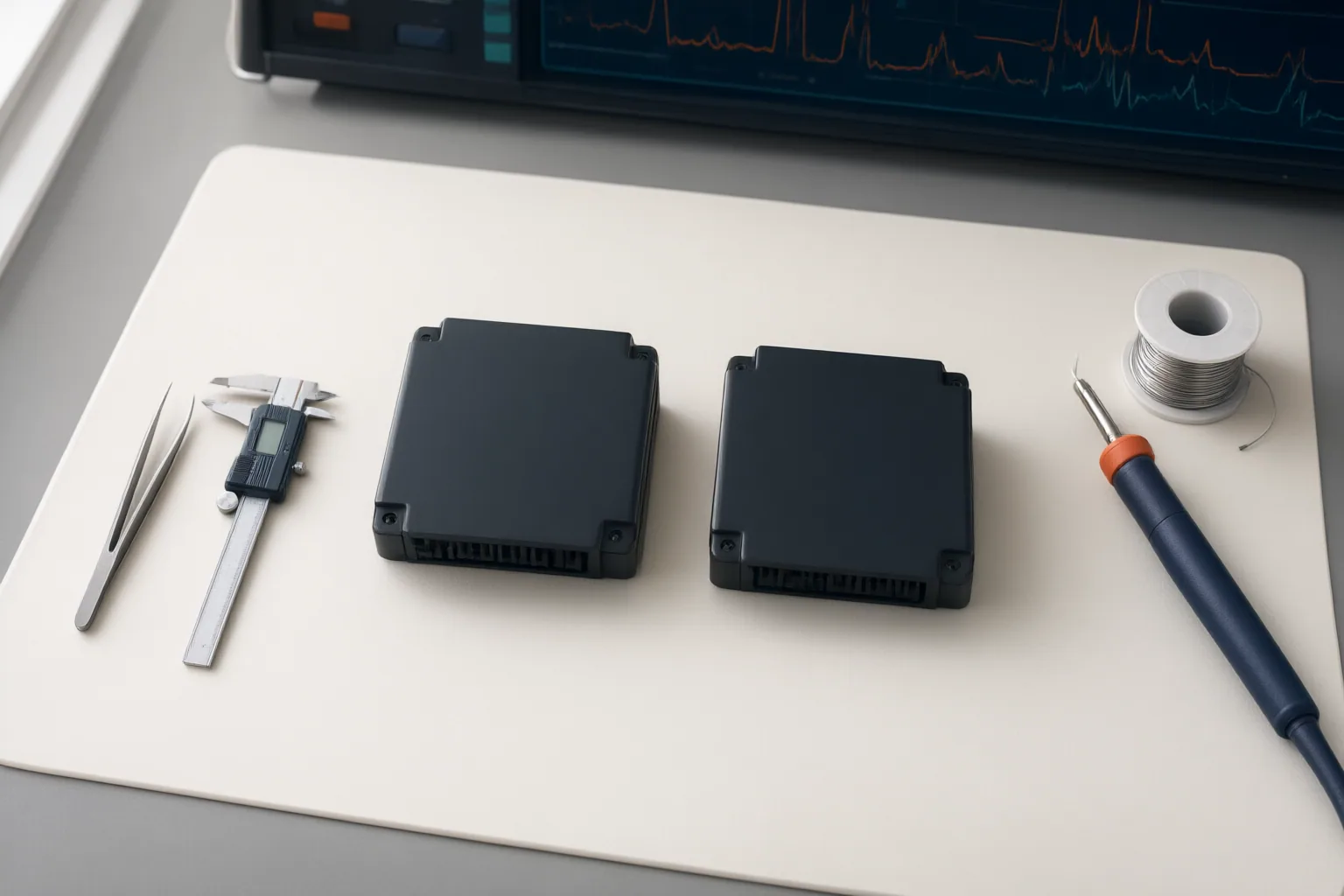
Begin with the job your bench needs to accomplish, then identify the relevant equipment or component category. Before buying, verify the product-level specifications, price, performance evidence, and suitability that broad references and retailer category pages do not establish.
Start With the Bench Task, Not a Product Name
Electronics includes devices that manipulate electrically charged particles, such as devices that control or amplify current or convert signals or power. Components may be active or passive, and they are commonly connected—often by soldering them to a printed circuit board—to form a circuit with a particular function.
That breadth makes the intended task a useful starting point for a purchase. First describe the function in plain language: assembling a circuit, making a measurement, preparing wire, joining conductors, or removing a soldered component. Then identify the category that serves that function.
A retailer catalog illustrates the range involved. Its test-equipment categories include multimeters, clamp meters, current probes, data loggers, test leads, and voltage testers. Its tool categories include soldering and desoldering equipment, wire strippers, crimping tools, cutters, pliers, screwdrivers, and tool kits. These listings establish that such purchasing categories exist; they do not determine which specific item fits a reader’s circuit, working method, or budget.
Match the Evidence to the Buying Decision
Different sources can answer different questions. A general electronics reference can explain what electronic devices and circuits do, including the distinction between active and passive components. A retailer catalog can show how a seller organizes components, tools, test equipment, connectors, wire, and power products.
Neither kind of evidence, as supplied here, establishes the performance, value, reliability, or comparative standing of an individual product. The available material contains no product-level specifications, prices, ratings, review counts, user feedback, benchmarks, or test results. It therefore cannot support a named-product recommendation or a claim that one option is better than another.
A useful editorial practice is to separate observations from judgments. “The store lists multimeters” is a sourced observation. “This multimeter is suitable for my work” would require additional product details and a clear account of the intended task. Likewise, category availability shows that an item can be offered for sale, not that it is accurate, durable, compatible, or good value. Treat each conclusion as limited by the evidence used to reach it.
Turn Uncertainty Into a Practical Shortlist
Missing evidence can become a checklist instead of a guess. Use this task-first process:
- Define the function. State what the circuit or bench operation must accomplish, such as measuring, soldering, desoldering, stripping wire, crimping, cutting, or fastening.
- Choose the relevant category. Narrow the search to the type of component, test equipment, or tool connected to that function.
- Record what remains unknown. For each candidate, list the product-level information needed to judge suitability. Depending on the decision, that may include specifications, price, ratings, reviews, or test results. These information types are not supplied in the current research package, so no values or requirements should be assumed.
- Compare equivalent evidence. Apply the same questions to every candidate and distinguish documented facts from personal priorities or editorial interpretation.
- Verify before purchasing. Check suitable product-level sources for each missing detail and confirm that the evidence actually concerns the exact item under consideration.
Keep commercial terms separate from product quality. The cited retailer advertises free ground freight on orders over $99, but that promotion does not demonstrate performance, suitability, or value. It also cannot replace a product price, specification, rating, review, or test result. A disciplined shortlist contains only candidates for which the details necessary to make the specific buying decision can be found and assessed.
Conclusion
An evidence-aware electronics purchase begins with a defined bench task, moves to the category that serves it, and ends with product-level verification. General references can establish concepts, while retailer catalogs can establish available categories and stated promotions; neither supports an unsupported product ranking. Choose one category that matches your immediate task, write down the specifications, price, performance evidence, and suitability information still needed, and verify those details with appropriate product-level sources before purchasing.
Disclosures and limitations
- This article was prepared with AI assistance using only the supplied general electronics reference and retailer catalog information; material claims are attributed through the listed source IDs.
- No individual product is recommended, and no affiliate relationship is stated in the supplied materials. Readers should independently verify product-level details and any commercial terms before purchasing.
Related reading
Sources
- Electronics – Wikipedia — en.wikipedia.org
- Sacramento Electronic Supply Co Webstore — Sacramento Electronic Supply Co Webstore